Redis is everywhere, and usually described in one word: “cache.” That’s true but thin — it misses why Redis is fast and what makes it uniquely useful. The honest one-line definition is “an in-memory data-structure store,” and unpacking those three ideas — in-memory, data-structure, store — explains everything the rest of the course builds on. Let’s get the model right first, with real numbers.
Three design choices
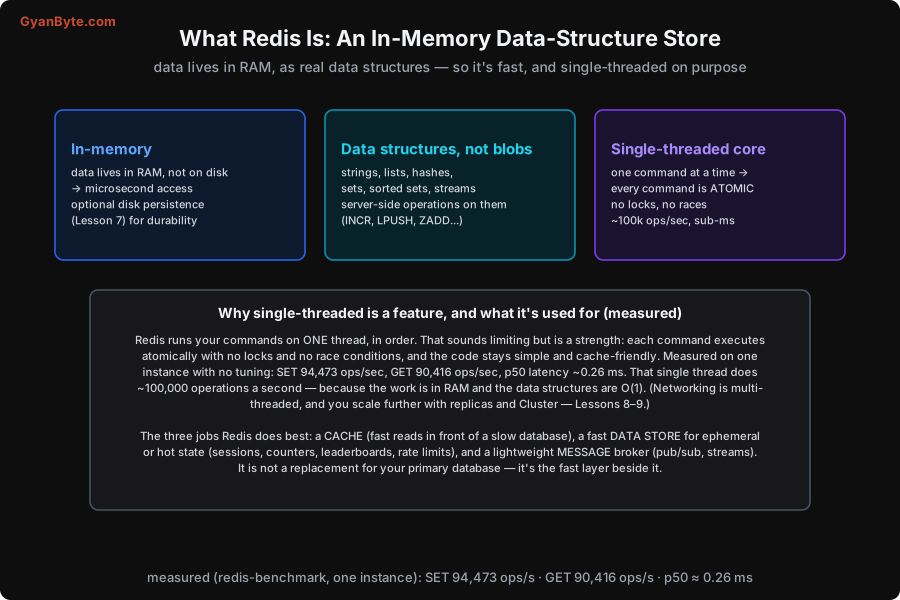
1. In-memory. Redis keeps the entire dataset in RAM, not on disk. That’s the root of its speed: RAM access is measured in nanoseconds and disk (even SSD) in microseconds-to-milliseconds, so operations complete in well under a millisecond. The trade-off is that your data must fit in memory, and memory is volatile — which is why persistence (Lesson 7) exists to survive restarts. But the core idea is simple: Redis is fast because it never waits for disk on the hot path.
2. Data structures, not blobs. Unlike a plain key-value cache that stores opaque bytes, Redis stores rich data structures — strings, lists, hashes, sets, sorted sets, streams — and gives you server-side operations on them: INCR a counter, LPUSH onto a list, ZADD to a sorted set, SINTER to intersect sets. This is the feature that makes Redis far more than a cache: you push computation to where the data lives, so a leaderboard update is one ZADD, not “read the whole list, sort in the app, write it back.” The data structures (Lesson 2) are the heart of Redis’s power.
3. Single-threaded core. Here’s the one that surprises people: Redis executes your commands on a single thread, one at a time, in order. That sounds like a bottleneck, but it’s a deliberate strength:
- Every command is atomic. Because only one command runs at a time, there are no locks, no race conditions, no partial updates to reason about.
INCRis atomic for free; a check-then-set is a single command, not a race. This makes Redis a superb coordinator (Lesson 10). - The code stays simple and fast. No lock contention, no context-switching overhead, cache-friendly execution. The single thread, working in RAM on O(1) structures, is astonishingly fast.
(Networking and some background work are multi-threaded in modern Redis, and you scale further with replicas and Cluster — Lessons 8–9 — but the command execution is single-threaded, and that’s the model to hold.)
Measured: how fast is “fast”?
Rather than hand-wave, I benchmarked a stock Redis 7 instance with no tuning:
- SET: 94,473 ops/sec, p50 latency ~0.26 ms.
- GET: 90,416 ops/sec, p50 ~0.27 ms.
So a single Redis instance handles roughly 100,000 operations per second at sub-millisecond latency, out of the box. That throughput comes from the three choices above: the data is in RAM (no disk wait), the operations are O(1) (simple structures), and the single thread runs them back-to-back with no locking overhead. And this is before pipelining (Lesson 5), which multiplies it 16–25×. For the vast majority of workloads, one Redis instance is more than enough — and when it isn’t, you scale with replicas (reads) and Cluster (sharding).
What Redis is for
Those properties point to three jobs Redis does better than almost anything:
- A cache — the classic use. Put Redis in front of a slow database or API; serve hot reads from RAM in microseconds, falling back to the source on a miss (Lesson 4). This is how you take load off a database and cut latency dramatically.
- A fast data store for ephemeral or hot state — sessions, counters, rate limits, leaderboards, feature flags, real-time analytics. Data that’s accessed constantly and can live in RAM (with persistence if it’s the source of truth).
- A lightweight message broker — pub/sub for live fan-out, and streams for durable queues (Lesson 6).
And crucially, what Redis is not: a replacement for your primary database. It’s the fast layer beside your durable store, not instead of it. Your system of record — the data you can never lose, that needs complex queries and transactions across large datasets — belongs in a database (the Database Internals course is about that side). Redis is the speed layer: hot data, fast operations, simple access patterns. Use each for what it’s good at.
With the model in place, the next lesson goes to the heart of Redis’s power: the data structures themselves.
Pitfalls to Avoid
- Treating Redis as “just a key-value cache.” You miss its real power — the data structures and server-side operations. A leaderboard, a rate limiter, a unique-count are a few commands in Redis; done naively elsewhere they’re whole subsystems.
- Forgetting data lives in RAM. Your dataset must fit in memory, and memory is the hard limit (Lesson 3). Treating Redis as infinite storage leads to the #1 incident: running out of RAM.
- Assuming single-threaded means slow. One thread in RAM on O(1) structures does ~100k ops/sec. But it also means one slow command blocks everything (Lesson 12) — keep commands O(1)/O(log n).
- Using Redis as your primary database. It’s the fast layer, not the system of record. Storing data you can’t lose or must query richly, with no durable backing, is a data-loss and capability trap.
- Ignoring persistence when Redis is a store. If Redis holds the only copy of something (not just a cache), a restart loses it unless you’ve configured persistence (Lesson 7). Decide: cache or store?
Quick Recap
- Redis is an in-memory data-structure store: data in RAM (microsecond access), stored as rich data structures (not blobs) with server-side operations, executed on a single thread.
- Single-threaded is a feature: every command is atomic (no locks/races), and the code stays simple and fast.
- Measured: one stock instance does SET 94,473 / GET 90,416 ops/sec at sub-ms p50 — ~100k ops/sec, before pipelining multiplies it (Lesson 5).
- Three jobs it’s best at: cache, fast store for hot/ephemeral state, lightweight message broker. It is not your primary database — it’s the fast layer beside it.
Next lesson: the heart of Redis’s power — the core data structures and when to use each.