Ask any successful engineer how they got their break, and the story almost always involves a person: someone who gave them a chance they weren’t obviously ready for, put their name forward, or argued for them in a room they weren’t in. That person was a sponsor, and sponsorship is one of the most powerful and least understood tools a staff engineer has. Growing others is also, in pure leverage terms (Lesson 2), among the highest-impact things you can do: a design doc helps one project, but raising an engineer’s level helps every project they touch for years. This lesson is about doing it well, and about the distinction, mentorship versus sponsorship, that makes the biggest difference.
Mentorship vs Sponsorship
These words get used interchangeably, and conflating them causes people to under-invest in the one that actually changes careers.
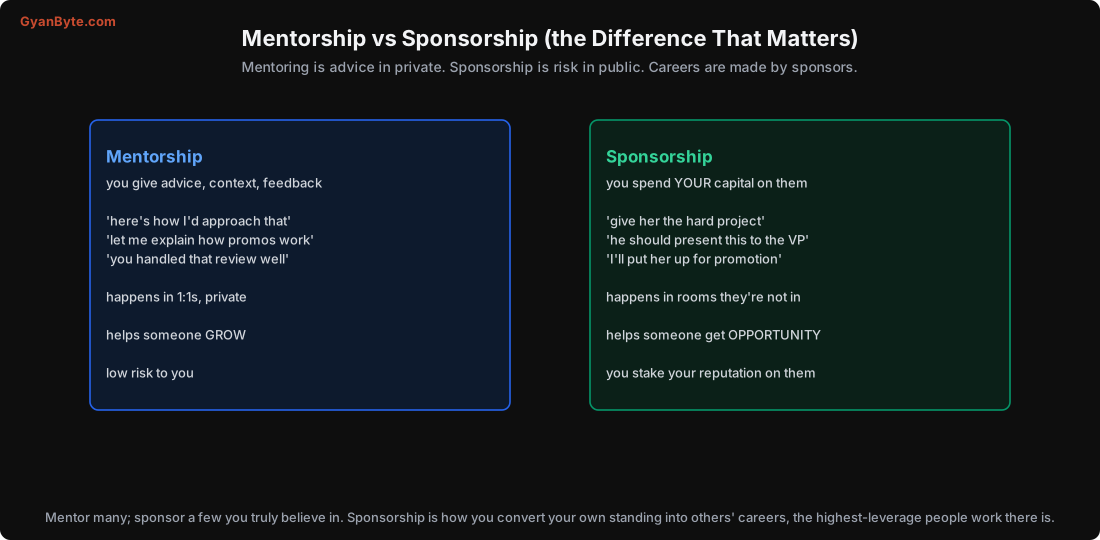
- Mentorship is giving advice, context and feedback, usually in private 1:1s. “Here’s how I’d approach that problem.” “Let me explain how the promotion process actually works.” “You handled that code review really well.” It helps someone grow, and it’s low risk to you, you’re sharing what you know. Mentorship is valuable and you should do a lot of it.
- Sponsorship is spending your own reputation and capital on someone, usually in rooms they’re not in. “Give her the hard project.” ”He should be the one to present this to the VP.” “I’m putting her up for promotion, and here’s the case.” It helps someone get opportunity, and it stakes your reputation on them, if they succeed, you were right; if they stumble, you backed them. That risk is exactly what makes it powerful.
The crucial insight: careers are made by sponsors, not just mentors. All the advice in the world doesn’t get you the stretch project or the promotion; someone with standing arguing for you does. Mentorship helps someone become ready; sponsorship gets them the chance to prove it. Most people have mentors; far fewer have sponsors, and the ones who rise fast usually have a sponsor.
So the guidance is: mentor many, sponsor a few. Mentor broadly, it’s generous and low-cost. But sponsor the few people you genuinely believe in, because sponsorship spends real capital and you only have so much. When you sponsor someone, you’re converting your hard-won standing into their opportunity, which is the highest-leverage people work there is, and a profound thing to do for someone’s career.
How to Sponsor Well
Sponsorship is more than a nice word; it’s specific actions:
- Hand over stretch opportunities. Give someone a project slightly beyond what they’ve proven, with support. The visible, hard, promotable work (Lesson 8) is what you want to route to people who are ready to grow, not hoard.
- Amplify in the rooms they’re not in. When a project succeeds, name who did it. When a name comes up for an opportunity, put forward the people you believe in, especially the ones who don’t self-promote.
- Make the case explicitly at promotion time. Help build the written case (Lesson 12) with evidence. Your vouching, as a trusted senior engineer, carries weight a manager’s alone might not.
- Create visibility. “You should present this at the eng all-hands.” “Write this up as a blog post.” Put people in front of audiences that matter.
- Share the credit, and more than share, transfer it. Deliberately let someone else take the lead and the credit on something you could have done. It costs you little and gives them a lot.
Give Feedback That Lands
Growing people requires feedback, and most feedback is either too vague to use (“great job!”) or too harsh to hear. Good feedback is:
- Specific: tied to a concrete thing. Not “your designs are weak” but “this design doc didn’t cover how it rolls back, which made it hard to approve.”
- Timely: soon after the event, while it’s fresh and changeable, not saved up for a review six months later.
- Kind and direct at once. The false choice people make is between being nice (and vague) and being honest (and brutal). The best feedback is both caring and clear, “radical candor”: you care about the person, so you tell them the truth they need. Vague kindness isn’t kind; it denies people the information they need to grow.
- Actionable: it points at something they can actually change, and ideally how.
- Balanced over time: people need to hear what they’re doing well (specifically, not “good job”) as much as what to improve, both so they repeat it and so they can hear the critical feedback when it comes.
And ask for feedback on yourself, loudly and genuinely. A staff engineer who visibly seeks and acts on feedback makes it safe for everyone to do so, and you have blind spots like everyone else.
Raise the Whole Team, Not One Favourite
One-on-one mentoring is good, but it doesn’t scale, you can only deeply mentor a few people. The higher-leverage move is to raise the whole team’s level:
- Teach through artifacts (Lesson 8): a doc, a template, a worked example, a recorded design review. One good “here’s how we think about X” doc mentors everyone who reads it, including future hires.
- Make your reasoning visible. When you review code or a design, explain the why, not just the fix, so everyone watching learns the thinking. A review comment that teaches a principle mentors silently.
- Run learning forums: a design review practice, a postmortem culture (Lesson 11), a brown-bag talk. These lift the baseline for everyone.
- Set the standards by example and by writing them down, so “good” is clear and learnable rather than locked in your head.
The goal is a team that gets better even when you’re not personally coaching each person, the multiplier mindset from Lesson 8 applied to people’s growth.
Do It Fairly
A hard but important truth: sponsorship and opportunity disproportionately flow to people who remind the sponsor of themselves. People sponsor those they’re comfortable with, who are often similar to them in background, communication style, or who self-promote loudly. The result is that quieter people, people from less-represented backgrounds, people who don’t fit the default mold, get overlooked, not through malice, but through the natural grain of who we notice and trust.
As someone with capital to spend, you can counteract this deliberately:
- Notice who’s doing good work quietly and not getting credit. Sponsor them.
- Route opportunities to the overlooked, not just the self-promoters. The best person for the stretch project isn’t always the loudest.
- Watch the glue-work distribution (Lesson 8): make sure the invisible work isn’t piling on the same people while the visible work goes to others.
- Check your own defaults. When you think “who should present this / lead this / get this chance”, pause and consider who you didn’t think of.
Done well, sponsorship is a lever not just for individuals but for making engineering fairer, and that’s some of the most meaningful impact a staff engineer can have.
Pitfalls to Avoid
- Mentoring but never sponsoring. Advice helps people get ready; only sponsorship gets them the chance. Careers need both.
- Sponsoring everyone. It spends real capital; sponsor the few you genuinely believe in, deeply.
- Vague feedback. “Great job” and “your work is weak” are both useless. Be specific, timely, kind and actionable.
- Choosing between kind and honest. The best feedback is both; vague niceness denies people what they need to grow.
- Only mentoring one-on-one. Raise the whole team through artifacts, visible reasoning and standards.
- Hoarding the visible, promotable work. Route stretch opportunities to people ready to grow.
- Sponsoring only people like you. Opportunity drifts to the familiar; deliberately sponsor the overlooked.
Quick Recap
- Growing others is top-tier leverage: it raises the team’s ceiling for years.
- Mentorship is private advice (low risk, helps growth); sponsorship is spending your public capital (stakes your reputation, grants opportunity).
- Careers are made by sponsors; mentor many, sponsor a few you truly believe in.
- Give feedback that’s specific, timely, both kind and honest, and actionable; raise the whole team through artifacts and visible reasoning.
- Sponsor fairly: opportunity drifts to the familiar, so deliberately back the quiet and overlooked.
Next lesson: shifting from people back to systems, keeping architecture healthy over time, managing tech debt, and running big migrations without breaking everything.