Here’s the hard truth at the center of the staff IC path: you can’t make anyone do anything. You can’t order a team to adopt your design, prioritise your project, or fix their flaky service. You have responsibility for outcomes that span many teams and authority over none of them. So how does anything happen? Through influence, and influence runs entirely on trust. The engineers who seem to magically get teams to move aren’t using magic; they’ve built trust deliberately, and they spend it wisely. This lesson is how.
Trust Is the Currency, and It Has Parts
Trust can feel like an innate quality some people have, but it’s buildable, and it helps to break it into parts. A useful model (adapted from The Trusted Advisor):
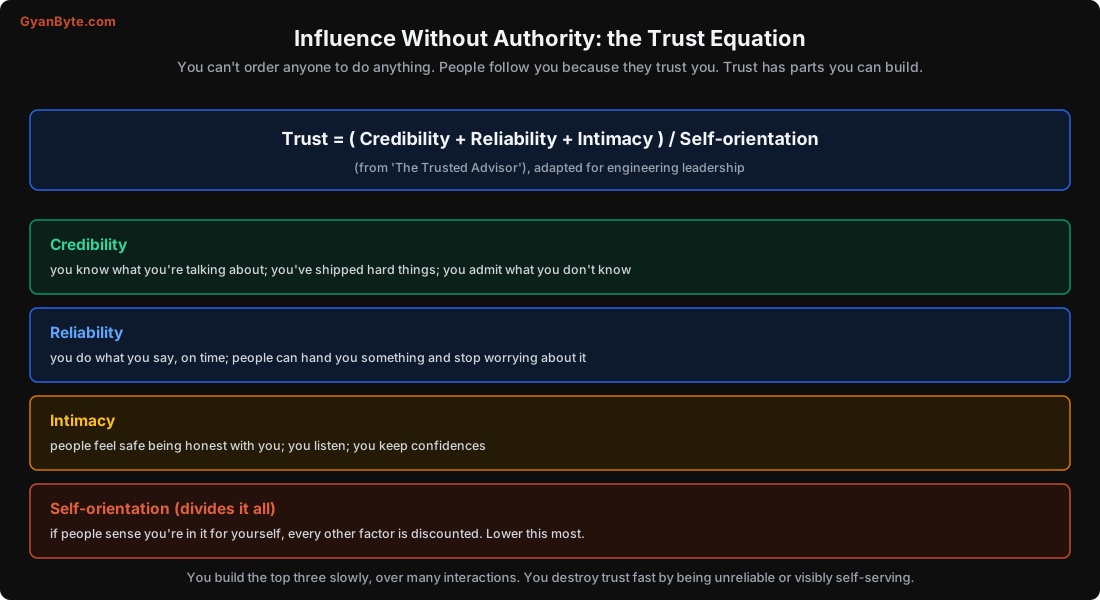
Trust = (credibility + reliability + intimacy) / self-orientation:
- Credibility: you know what you’re talking about. You’ve shipped hard things, your technical judgment has been right before, and, crucially, you admit what you don’t know. Fake confidence destroys credibility the moment it’s caught; honest “I’m not sure, let me find out” builds it.
- Reliability: you do what you say, when you said you’d do it. This is the quiet, unglamorous one, and it’s enormous. When people can hand you something and stop worrying about it, you become someone they want to work with. Flakiness, even from a brilliant engineer, is trust-poison.
- Intimacy: people feel safe being honest with you. They’ll tell you the real status, the actual concern, the thing they wouldn’t say in the big meeting. You build this by listening, by keeping confidences, by not punishing bad news.
- Self-orientation (the denominator, divides everything): if people sense you’re in it for yourself, your promotion, your pet technology, your visibility, every other factor gets discounted. A credible, reliable, warm person who’s obviously self-serving is still not trusted. This is the one to watch most, because it’s easy to slip into without noticing, and it quietly undermines everything else.
The practical reading: build the top three slowly, over many interactions (there’s no shortcut; trust is earned in drops), and protect the denominator fiercely. You build trust in drops and lose it in buckets, one visibly self-serving move or one broken commitment undoes months of good work.
Spend Your Influence Where It Counts
Even with trust, you have finite time and finite influence capital. A common mistake is spending it all on the wrong people, the ones who argue loudest rather than the ones who actually decide. Map your stakeholders:
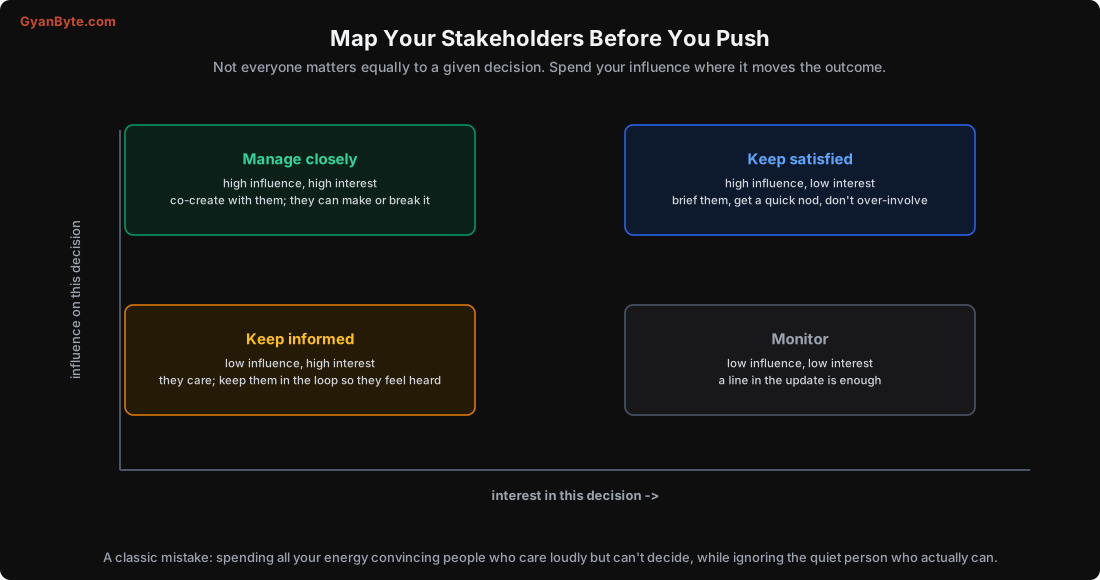
For any given decision or project, place the people who matter on two axes, how much influence they have over the outcome, and how much interest they have in it:
- High influence, high interest → manage closely. These people can make or break it. Co-create with them; bring them in early; make them partners, not obstacles.
- High influence, low interest → keep satisfied. They can block you but don’t care much day-to-day. Brief them concisely, get a quick nod, don’t drown them in detail they didn’t ask for.
- Low influence, high interest → keep informed. They care a lot but can’t decide. Keep them in the loop so they feel heard, that respect is worth it, but don’t let their volume set your agenda.
- Low influence, low interest → monitor. A line in the update is enough.
The classic error this prevents: spending all your energy winning over the person who cares loudest and argues hardest, who turns out to have no real say, while neglecting the quiet senior person who will actually make the call. Figure out who decides, and invest there. (This connects to Lesson 5: ambiguity about who decides is itself a problem; mapping stakeholders often reveals it.)
You Will Be Overruled: Disagree and Commit
No matter how good your influence, you will regularly lose arguments, sometimes ones you’re right about. How you handle being overruled is one of the biggest factors in your long-term reputation, far bigger than being right in any single case.
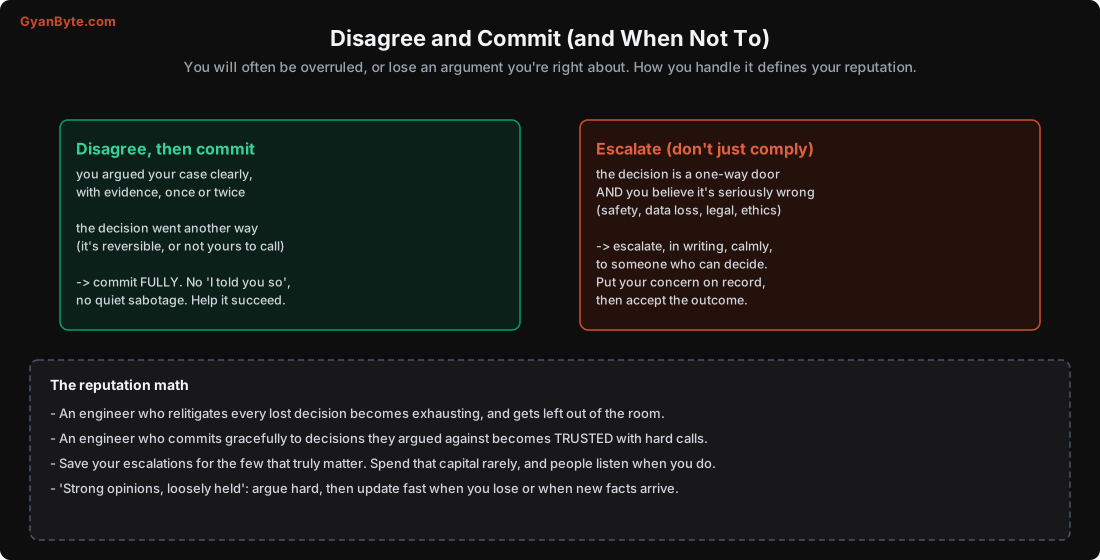
The default, and the mark of a trusted senior engineer, is disagree and commit:
- You made your case clearly, with evidence, once or twice. That’s your job, argue hard for what you believe.
- The decision went another way (it was reversible, or it genuinely wasn’t yours to call).
- So you commit fully. No “I told you so” when it goes wrong. No quiet sabotage or dragging your feet. You actively help it succeed, because the team succeeding matters more than you being proven right.
This is counterintuitive to people who think being right is the goal. But watch the reputation math: an engineer who relitigates every lost decision becomes exhausting, and quietly gets left out of the rooms where decisions happen. An engineer who argues passionately and then commits gracefully to a decision they disagreed with becomes someone leaders trust with hard calls, because they know you’ll disagree honestly and then row in the same direction. “Strong opinions, loosely held”, argue hard, then update fast when you lose or when new facts arrive.
The exception is escalation, and it’s narrow. If a decision is a one-way door (Lesson 5) and you believe it’s seriously wrong, data loss, a security hole, a legal or ethical problem, then you don’t just comply. You escalate: in writing, calmly, to someone who can decide, putting your concern on the record. Then you accept whatever they decide. The key is to spend this capital rarely. An engineer who escalates every disagreement becomes someone whose escalations are ignored. One who escalates maybe twice a year, only on the things that truly matter, is one whose escalation makes everyone stop and pay attention. Save it for when it counts.
Day-to-Day Influence Habits
Beyond the big frameworks, influence is built in small, consistent ways:
- Give credit generously, take blame readily. Publicly crediting others’ contributions and privately owning your own mistakes builds trust fast and costs you nothing real.
- Make others look good. If you help a teammate’s idea succeed and they get the credit, you’ve made an ally and lowered your self-orientation score at the same time.
- Listen first, genuinely. People support what they helped shape. Understanding someone’s actual concern (not the one they stated) is often what unlocks their support.
- Be useful before you need something. The time to build a relationship with another team is before you need their help, not the day you show up asking for a favour.
- Communicate in their terms. Frame your ask in terms of their goals and constraints, not yours (this is the “write for the reader” idea from Lesson 4, applied to people).
- Follow through visibly. Every time you do what you said, your reliability score ticks up, and reliability is the quiet engine of influence.
None of this is manipulation, it’s the opposite. It’s being the kind of colleague people genuinely want to work with and trust, which is both the right way to behave and, not coincidentally, the most effective.
Pitfalls to Avoid
- Relying on being right instead of being trusted. Authority you don’t have won’t make people move; trust will.
- Neglecting the denominator. Visible self-orientation discounts all your other virtues. Watch it hardest.
- Flakiness. Reliability is quiet but huge; broken commitments poison trust fast.
- Spending influence on the loudest, not the decider. Map stakeholders; invest where the decision is actually made.
- Relitigating every lost decision. It makes you exhausting and gets you left out. Disagree, then commit.
- Escalating too often. Spend that capital rarely, or your escalations stop meaning anything.
- Only building relationships when you need something. Be useful first; the favour bank fills before you draw on it.
Quick Recap
- You have no authority, so influence is the job, and influence runs on trust.
- Trust = (credibility + reliability + intimacy) / self-orientation; build the top three over time, and guard against seeming self-serving.
- Map stakeholders by influence and interest; spend your energy on who actually decides, not who argues loudest.
- When overruled, disagree and commit, back the decision fully; it’s what makes leaders trust you with hard calls.
- Escalate only for a seriously-wrong one-way door, rarely, so it carries weight when you do.
Next lesson: the unglamorous work that holds everything together, glue work, and how to do it in a way that’s high-leverage rather than a career trap.