We’ve covered a lot of specific defenses. This final lesson is about the thing that ties them together and makes them stick: weaving security into how you build software, so it’s a natural part of your process rather than a frantic scramble before launch or after a breach. And because security ultimately exists to protect people’s data, we close with privacy and compliance — the responsibility you carry for the data users trust you with, and what India’s DPDP Act asks of you in concrete engineering terms. This is where security stops being a checklist and becomes a way of working.
Shift Left: The Economics of Building It In
There’s a well-documented, intuitive truth in software: the later you catch a problem, the more it costs to fix. A flaw caught while you’re still sketching the design is almost free — you just draw it differently. The same flaw caught in code review costs a little more; in testing, more; in staging, more still; and discovered in production as a breach, it can cost you customers, regulatory fines, incident response, and reputation. The shape of that curve is the entire argument for shifting security left — moving it earlier in the development lifecycle.
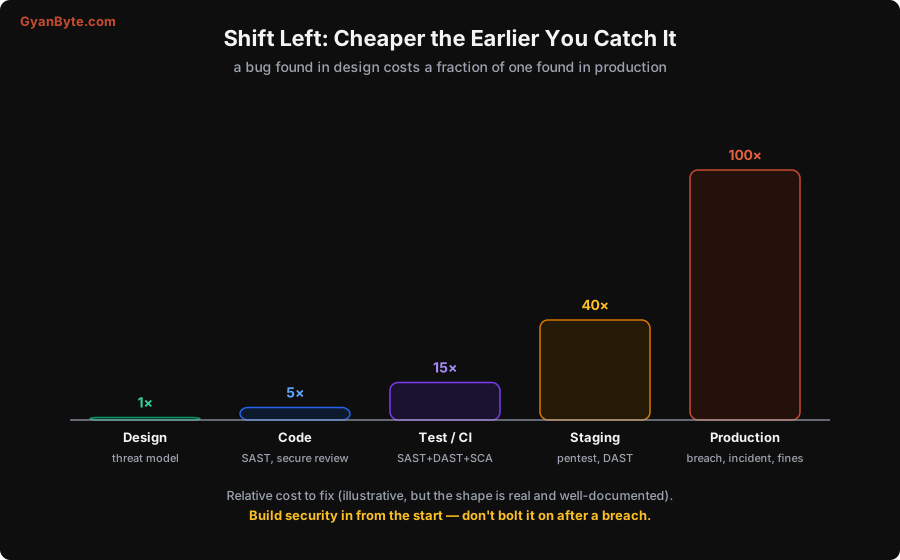
(The exact multipliers are illustrative, but the shape is real and consistently observed.) Shifting left in practice means putting security activity at each stage rather than only at the end:
- Design — threat-model (Lesson 1). The cheapest security you’ll ever do is a whiteboard conversation that avoids a bad design before any code exists.
- Code — secure coding practices and SAST (static analysis, Lesson 9) plus secret scanning, catching injection, hardcoded secrets, and dangerous patterns as you write and review.
- Test / CI — automated security tests in the pipeline: SAST on your code, SCA on your dependencies (Lesson 9), and DAST (Dynamic Application Security Testing — tools that probe your running app for vulnerabilities like a scanner-attacker would).
- Staging — deeper checks before production: DAST against a full environment, and periodic penetration testing by humans for the things tools miss.
- Production — monitoring and detection (Lesson 11), because some things only show up live.
The key move is making the automatable parts part of CI, so they run on every merge without anyone remembering (Lesson 9). A security check that depends on someone choosing to run it won’t run. A security check that blocks the pull request until it passes, runs every time. That’s the whole idea behind “DevSecOps”: security as an automated, built-in property of your pipeline, not a separate gate at the end.
Make Security a Culture, Not a Blocker
The failure mode of security programs is becoming the department of “no” — the team that slows everyone down, so engineers route around them. Avoiding that is mostly about making the secure path the easy path:
- Build paved roads (secure defaults). The single most effective cultural lever (the same idea as in platform/architecture work): provide templates, libraries, and tooling where the right way is also the easiest way. A service template that already includes authentication, input validation, logging, and safe DB access means engineers get security “for free” by using the standard path. People follow the path of least resistance — so make the least-resistance path secure.
- Give engineers tools and knowledge, not just rules. Scanners in their IDE, clear guidelines, this kind of training. Security is everyone’s job, and developers who understand why make better decisions than developers handed a list of don’ts.
- Treat findings blamelessly (Lesson 11). When a scan or review finds a vulnerability, that’s the process working, not someone failing. A blameless culture surfaces problems early; a blameful one buries them.
- Make the security team a partner, not a gate. Involve them early (at design), so they help shape good solutions rather than rejecting finished ones. Early and collaborative beats late and adversarial.
Security done this way compounds quietly: every paved road, every secure default, every bit of shared knowledge raises the whole team’s baseline without anyone having to be heroic.
Privacy: Protecting the People in the System
Security and privacy are related but distinct: security protects the system; privacy protects the people whose data is in it. You can be secure and still violate privacy (collecting far more data than you need and guarding it well is still a privacy problem). As an engineer handling user data, privacy is increasingly both an ethical duty and a legal one — and in India, the Digital Personal Data Protection (DPDP) Act 2023 now governs it.
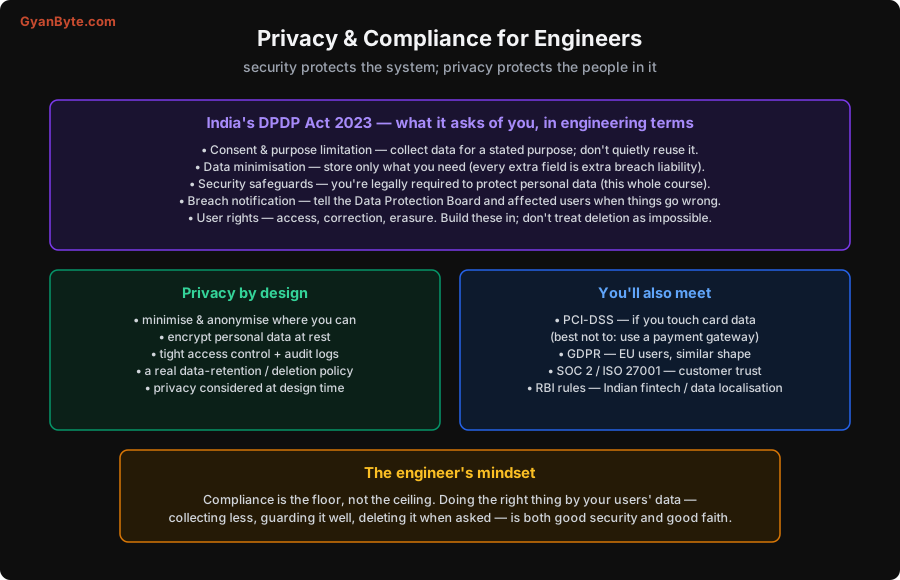
What the DPDP Act asks, translated into engineering terms:
- Consent and purpose limitation — collect personal data for a clear, stated purpose with consent, and don’t quietly reuse it for something else. In code, that means tracking why you hold each piece of data and not repurposing it silently.
- Data minimisation — collect and keep only what you actually need. This is also good security: every extra field of personal data is extra breach liability. The data you don’t hold can’t be stolen.
- Security safeguards — you are legally required to protect personal data, which is essentially this entire course. Weak security is now also a compliance failure.
- Breach notification — notify the Data Protection Board and affected users when a personal-data breach occurs (Lesson 11). Build this into your incident plan.
- User rights — people can request access, correction, and erasure of their data. Build these capabilities in from the start; “we can’t actually delete a user’s data” is both a compliance problem and a design smell.
The engineering practice that satisfies all of this is privacy by design — considering privacy at design time, not retrofitting it: minimise and anonymise where you can, encrypt personal data at rest (Lesson 6/7), enforce tight access control and audit logging (Lessons 3, 11), and have a real data-retention and deletion policy (don’t keep everything forever). Design the system so that honouring a deletion request, or proving who accessed what, is straightforward rather than impossible.
You’ll likely meet other regimes too, depending on what you build: PCI-DSS if you handle card data (best avoided by using a payment gateway so card numbers never touch your servers), GDPR for EU users (similar shape to DPDP), SOC 2 / ISO 27001 as customer-trust certifications, and RBI rules for Indian fintech (including data-localisation requirements). You don’t need to be a lawyer, but you should know which apply to your product and design accordingly.
The Mindset to Carry Forward
End on this, because it’s the thread through the whole course: compliance is the floor, not the ceiling. Meeting the legal minimum is necessary but it’s not the goal. The goal is doing right by the people whose data you hold — collecting less of it, guarding it well, being honest when something goes wrong, and deleting it when they ask. That’s simultaneously good security, good privacy, good compliance, and good faith. Teams that treat it as a genuine responsibility rather than a checkbox build systems people can actually trust — and trust, in the end, is what all of this security work is for.
You now have the full arc: think like an attacker, authenticate and authorize correctly, keep data and code separate, defend the browser boundary, use crypto without inventing it, manage secrets and keys, secure your APIs, your supply chain, and your infrastructure, detect and respond when something slips through, and build it all in from the start while honouring your users’ privacy. None of it is exotic. It’s a set of solid, repeatable habits — and practised consistently, they stop the overwhelming majority of what goes wrong.
Pitfalls to Avoid
- Treating security as a final gate. Flaws get exponentially more expensive the later you catch them. Shift left — threat-model at design, scan in CI, test before prod.
- Manual, skippable security steps. If it depends on someone remembering, it won’t run. Automate SAST/SCA/DAST into the pipeline so every merge is checked.
- Being the department of “no”. Engineers route around blockers. Build paved roads and secure defaults so the easy path is the secure path.
- Confusing security with privacy. You can be secure and still over-collect. Protect the people, not just the system.
- Collecting and keeping data you don’t need. Every extra field is breach liability and a DPDP problem. Minimise and set retention/deletion policies.
- No way to honour access/correction/erasure requests. Build user-rights capabilities in from the start; “we can’t delete it” is a design failure.
- Treating compliance as the ceiling. The legal minimum isn’t the goal; doing right by users’ data is. Compliance is the floor.
Quick Recap
- Shift left: the cost of fixing a flaw rises steeply the later you catch it, so threat-model at design and run SAST, SCA, and DAST automatically in CI (plus periodic pentests).
- Make security a culture, not a blocker: paved roads and secure defaults so the easy way is the safe way, blameless findings, security as an early partner.
- Privacy protects the people in the system. India’s DPDP Act requires consent/purpose limitation, data minimisation, security safeguards, breach notification, and honouring user rights — all engineering work, met by privacy by design.
- Know the regimes you touch (PCI-DSS, GDPR, SOC 2/ISO 27001, RBI), but remember compliance is the floor, not the ceiling — doing right by users’ data is the goal, and trust is what all of this is for.
That’s the course. Go build things that are secure by default — and come back to any lesson as a reference when you’re about to design the real thing.