A single Redis instance does ~100,000 operations per second (Lesson 1) — but that number hides something important: at that rate, Redis is mostly waiting on the network, not doing work. Which means the single biggest thing you can do for throughput isn’t tuning Redis — it’s changing how your client talks to it. This lesson is pipelining (the measured 16–25× lever) and the atomicity tools: transactions, optimistic locking, and Lua scripts.
Pipelining: batch the round trips
Normally, a client sends one command, waits for the reply, then sends the next. Each command is a full network round trip, and at sub-millisecond Redis execution times, that round trip — not Redis — dominates. Pipelining breaks the lockstep: the client sends many commands back-to-back without waiting for each reply, then reads all the replies together. Dozens of commands now ride in one (or a few) round trips.
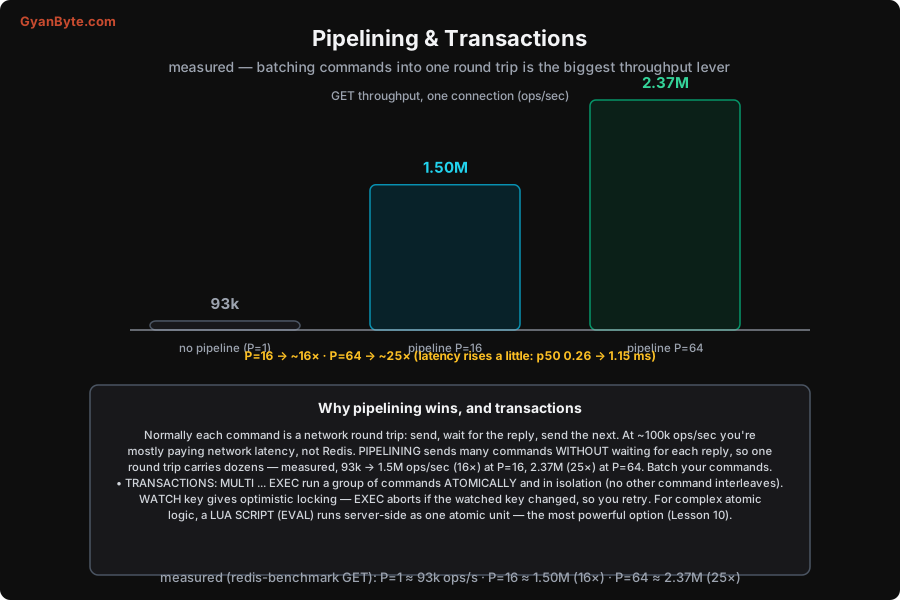
The effect is dramatic. I measured GET throughput on one connection at different pipeline depths:
- No pipeline (P=1): ~93,000 ops/sec (p50 ~0.26 ms).
- Pipeline P=16: 1,497,006 ops/sec — a 16× increase (p50 ~0.43 ms).
- Pipeline P=64: 2,369,820 ops/sec — a 25× increase (p50 ~1.15 ms).
Sixteen to twenty-five times the throughput, from the same Redis, just by not waiting for each reply. Notice the trade-off is tiny: latency per command barely rose (0.26 → 1.15 ms even at P=64), because you’re amortising the round trip, not slowing Redis. Whenever you issue several commands at once — populating a cache, writing a batch, reading many keys — pipeline them. Most client libraries make this a pipeline() call. (The related MGET/MSET do this for multi-key get/set in a single command.) Pipelining is the highest-leverage, lowest-effort Redis optimisation there is.
One caution: pipelining is about throughput, not atomicity — the commands in a pipeline still interleave with other clients’ commands, and you don’t see replies until the end (so you can’t branch on an earlier reply mid-pipeline). For atomicity, you need the next tools.
Transactions: MULTI / EXEC
Redis transactions group commands so they execute atomically and in isolation. You queue commands between MULTI and EXEC:
MULTI
INCR orders:count
LPUSH orders:recent "order:7"
EXEC
Between MULTI and EXEC, the commands are queued, not run. EXEC runs them all as a single unit — no other client’s command interleaves, and they all execute in order. (Note: Redis transactions don’t roll back on a logic error the way a SQL transaction does — if one command fails, the others still run; the guarantee is atomic isolation, not rollback. Validate inputs before queueing.)
This gives you “these commands happen together, with nothing in between” — useful when a logical operation spans several commands and you can’t let another client see a half-done state.
Optimistic locking: WATCH
What about check-then-act — “read a value, and write only if it hasn’t changed”? That’s a classic race. Redis solves it with WATCH (optimistic locking):
WATCH balance:42
val = GET balance:42          # read and decide in the client
MULTI
SET balance:42 <new value>
EXEC                          # aborts (returns nil) if balance:42 changed since WATCH
WATCH marks a key; if that key is modified by anyone between the WATCH and the EXEC, the EXEC aborts (does nothing) and you retry the whole read-decide-write. It’s optimistic: you assume no conflict and only pay (a retry) when there is one. This is the Redis way to do conditional updates safely without holding a lock — great for low-contention check-then-set.
Lua scripts: the most powerful atomicity
For genuinely complex atomic logic — multiple steps with branching that must all happen as one indivisible operation — the strongest tool is a Lua script run with EVAL. Redis executes the whole script server-side, atomically, as a single command (the single thread runs it start to finish with nothing interleaving):
-- atomic "decrement stock only if available", in one round trip and one atomic op
if tonumber(redis.call('GET', KEYS[1])) > 0 then
  return redis.call('DECR', KEYS[1])
else
  return -1
end
A Lua script combines the best of everything: it’s atomic (no interleaving), it’s one round trip (the logic runs on the server, not the client), and it can do arbitrary conditional multi-step logic. It’s the go-to for rate limiters, conditional updates, custom atomic operations, and distributed-lock release (Lesson 10). The rule of thumb: when you need several steps to be one atomic operation, write a Lua script. (Keep scripts small and fast — they block the single thread while running.)
So: pipeline for throughput (16–25×), MULTI/EXEC for atomic grouping, WATCH for optimistic check-then-set, and Lua for complex atomic logic. Next we look at Redis as a message broker: pub/sub and streams.
Pitfalls to Avoid
- Issuing many commands one-by-one. At ~100k ops/sec you’re mostly paying network latency. Not pipelining leaves 16–25× throughput on the table. Batch commands (pipeline, or
MGET/MSET). - Confusing pipelining with atomicity. A pipeline is about round trips, not isolation — other clients’ commands still interleave, and you can’t branch on mid-pipeline replies. Use
MULTI/EXECor Lua for atomicity. - Expecting SQL-style rollback from MULTI/EXEC. Redis transactions don’t roll back on a command error — the rest still execute. Validate before queueing; use Lua for conditional logic.
- Doing check-then-set without WATCH (or Lua). Reading a value and writing back based on it is a race if another client changes it in between. Use
WATCH(optimistic) or a Lua script (atomic). - Huge pipelines or slow Lua scripts. A giant pipeline buffers lots of replies in memory, and a long Lua script blocks the single thread (Lesson 12), stalling all other clients. Keep batches reasonable and scripts short.
- Using Lua for everything. Lua is powerful but harder to debug and blocks the thread. Reach for it when you genuinely need multi-step atomicity, not for simple operations a single command handles.
Quick Recap
- Redis spends most of its time on network round trips, so pipelining (send many commands without waiting for each reply) is the biggest throughput lever. Measured (GET): ~93k → 1.50M ops/sec at P=16 (16×) → 2.37M at P=64 (25×), latency barely rising. Batch whenever you issue several commands.
MULTI/EXECrun a group atomically and in isolation (no interleaving) — but no rollback on errors.WATCHadds optimistic locking for check-then-set:EXECaborts if the watched key changed, so you retry.- Lua (
EVAL) runs multi-step logic server-side as one atomic unit — the most powerful tool for complex atomic operations (and lock release, Lesson 10). Keep scripts small.
Next lesson: Redis as a message broker — pub/sub and streams (fire-and-forget vs durable).