The pipeline ends where it began — with the business. Modelled, trustworthy data (Lessons 7, 11) has to reach the people and systems that use it, and it has to do so affordably and accountably. This final lesson covers the last mile: serving data to consumers, keeping the warehouse bill from spiralling, and the governance that keeps a growing data platform trustworthy rather than an expensive mess. It also ties together every technique in the course, because — as you’ll see — they’re all cost levers too.
Serving, Cost, and Governance
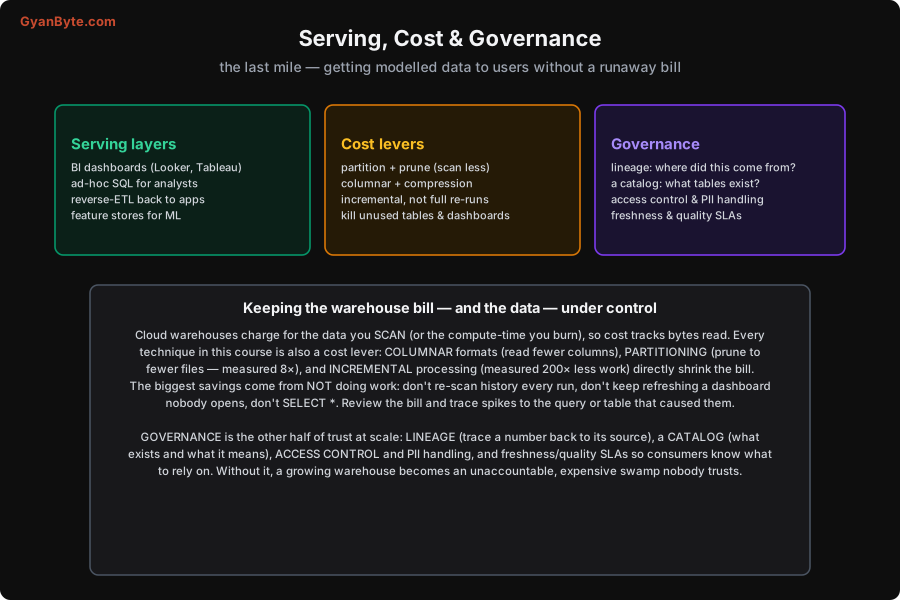
Serving: getting data to consumers
The modelled gold-layer tables (Lesson 7) are consumed in several ways, and part of the data engineer’s job is to serve each well:
- BI and dashboards (Looker, Tableau, Power BI, Metabase) — the most common consumer. Analysts and business users slice the star-schema tables. Your job: model the data so these queries are fast and intuitive, and keep the serving tables fresh.
- Ad-hoc SQL — analysts and data scientists exploring directly. They need clean, well-documented tables and reasonable query performance.
- Reverse-ETL — pushing modelled data back into operational tools (a customer’s computed lifetime-value into the CRM, a segment into the marketing platform). The warehouse becomes a source for applications, not just a sink.
- Feature stores for ML — serving the features models need, consistently, for both training (historical) and inference (fresh). The bridge from analytics to production ML.
Serving is where all the upstream work pays off: the whole pipeline exists so these consumers get trustworthy data, fast.
Cost: every technique is a cost lever
Cloud data platforms mostly charge by data scanned (BigQuery) or compute-time consumed (Snowflake, Spark clusters) — so cost tracks bytes read. This is the key insight that ties the course together: almost every performance technique you’ve learned is also a cost-reduction technique, because reading less data is both faster and cheaper:
- Columnar formats (Lesson 4) — reading only the columns a query needs (measured 6.8× less work for a one-column aggregate) is 6.8× fewer bytes scanned, hence cheaper.
- Partitioning and pruning (Lesson 6) — scanning 1 of 30 files instead of all (measured 8×) is 8× fewer bytes, hence ~8× cheaper for that query.
- Incremental processing (Lesson 10) — processing 5M new rows instead of re-scanning 1B (measured ~200×) is ~200× less scanning, hence ~200× cheaper for that job.
So the levers in the diagram — partition + prune, columnar + compression, incremental not full, kill unused tables and dashboards — are the same engineering you’ve already learned, now viewed through the cost lens. But the single biggest saving is strategic: don’t do work you don’t need to. Don’t re-scan all of history every run (go incremental). Don’t keep auto-refreshing a dashboard nobody opens. Don’t SELECT * when you need three columns. Don’t materialise tables no one queries. A startling fraction of warehouse bills is pure waste — recomputing and re-scanning for outputs nobody uses. The discipline: review the bill regularly, and trace spikes to the specific query or table that caused them (this is the observability mindset, applied to cost — the Observability course’s cost-engineering lesson is the same idea for telemetry).
Governance: trust at scale
The other half of a mature platform is governance — the structure that keeps a growing data platform accountable and trustworthy. As the number of tables, pipelines and users grows, without governance you get the “data swamp” (Lesson 5) at organisational scale: nobody knows what exists, where a number came from, or whether to trust it. The pieces:
- Lineage — trace any number back through the transformations and sources that produced it. When a dashboard looks wrong, lineage tells you which upstream table or transform to check. (dbt and modern catalogs generate this automatically from the model graph.)
- A data catalog — a searchable inventory of what tables exist, what each column means, who owns it, and how fresh it is. Without it, people rebuild datasets that already exist and query the wrong table.
- Access control and PII handling — who can see what, with personal/sensitive data protected, masked or access-restricted. This is both a trust and a legal/compliance requirement (the Security course covers the principles).
- Freshness and quality SLAs — explicit promises about how up-to-date and how correct a dataset is, so consumers know what they can rely on (and know when something’s stale).
Without governance, a growing warehouse becomes an unaccountable, expensive swamp that nobody trusts — the exact opposite of the pipeline’s purpose. With it, the platform scales: people find and trust the right data, costs stay visible and attributable, and sensitive data stays protected.
That’s the Course
Step back and see the whole pipeline you’ve built across these twelve lessons: data engineering is the discipline of moving data from where it’s created (OLTP) to where it answers questions (OLAP), reliably, at scale, and affordably. You get it in (ingestion, CDC), store it cheaply and scannably (columnar Parquet, lakehouse, partitioning), transform it into useful models (ELT, dbt, star schemas) with engines sized to the job (single-node to Spark), handle real-time where needed (Kafka), run it all reliably (idempotent, incremental, orchestrated), make it trustworthy (dedup, tests, contracts), and serve it without a runaway bill or an ungoverned swamp. And throughout, the big claims were grounded in real measurements — Parquet’s 6.8× column scans, partition pruning’s 8×, skew’s 5.9×, dedup on a 4.8% duplicate stream, 31M rows/sec on one machine, and incrementality’s 200× — so you can reason about data systems with real numbers, not folklore. Go build pipelines that people can trust; that trust, more than any single technology, is what data engineering delivers.
Pitfalls to Avoid
- Ignoring the bill until it’s huge. Warehouse cost tracks bytes scanned and creeps up silently as data and dashboards grow. Review it regularly and trace spikes to the query/table that caused them — treat cost like an observable signal.
SELECT *and full re-scans. Reading all columns and all history when you need a few columns and the latest partition is the most common source of waste. Project columns, partition-prune, and process incrementally — they’re cost levers, not just speed ones.- Recomputing outputs nobody uses. Auto-refreshing unopened dashboards and materialising unqueried tables burns money for nothing. Kill unused assets; the biggest saving is not doing the work.
- No lineage. When a number is wrong and you can’t trace it to its source, debugging takes hours and trust erodes. Capture lineage (dbt/catalog) so every number is traceable.
- No catalog or ownership. Without a searchable inventory of what exists and who owns it, people rebuild existing datasets and query the wrong tables. Maintain a catalog with owners and definitions.
- Weak PII and access control. Serving sensitive data without masking or access restrictions is a trust and compliance failure. Govern access and protect PII from the start, not after an incident.
- No freshness/quality SLAs. If consumers don’t know how fresh or reliable a dataset is, they either distrust good data or trust stale data. Publish SLAs so people know what to rely on.
Quick Recap
- Serving: modelled data reaches users via BI dashboards, ad-hoc SQL, reverse-ETL (back into apps), and feature stores (ML). The whole pipeline exists to serve these, fast and trustworthy.
- Cost tracks bytes scanned, so every technique in the course is a cost lever: columnar (6.8×), partition pruning (8×), incremental (200×) all mean fewer bytes read, hence cheaper. The biggest saving is not doing needless work — no full re-scans, no
SELECT *, no refreshing unopened dashboards. Review the bill and trace spikes. - Governance keeps a growing platform trustworthy: lineage (trace a number to its source), a catalog (what exists/means/owns), access control + PII handling, and freshness/quality SLAs. Without it, the warehouse becomes an unaccountable, expensive swamp.
- The course in one line: move data from OLTP to OLAP reliably, at scale, and affordably — ingest, store columnar/partitioned, transform and model, process (single-node to Spark), stream where needed, orchestrate idempotently and incrementally, make it trustworthy, and serve it governed and cheap. Grounded in real measurements throughout.
That’s the course — go build pipelines people can trust.