
coding-interview|May 11, 2019|2 min read

Insertion Sort Algorithm

TL;DR

Pick each element and insert it into its correct position in the already-sorted left portion by shifting larger elements right. O(n²) worst case, O(n) best case.

Insertion Sort Algorithm

Its a kind of incremental insertion technique, where the algorithm build up sorting by first sorting n-1 items.

Or, we can say that we pick an element on n-1 items, and insert in a position where all items on the left side are less than or equal to this number.

Insertion Sort Algorithm

The algorithm works in two loops, where outer most loop iterate over complete array. To be more precise, We iterate from index-1 to end of array. Leaving index-0 to be used by inner loop.

In inner loop, the loop variable takes the index from outer loop index variable. It takes a backup of the value present on that index, and go backward toward 0-index. It shift previous elements to next position unless they are greater than the value for which we have taken backup.

In short, inner loop tries to sort the n-1 part of array by shifting any bigger element to right. And, insert the element to the final position.

See the code here:

public void sort(int[] arr) {
    int len = arr.length;
    for (int i=1; i<len; i++) {
        int key = arr[i];
        int j = i-1;
        while (j >= 0 && key < arr[j]) {
            arr[j+1] = arr[j];
            j--;
        }

        arr[j+1] = key;
    }
}

Graphical Example
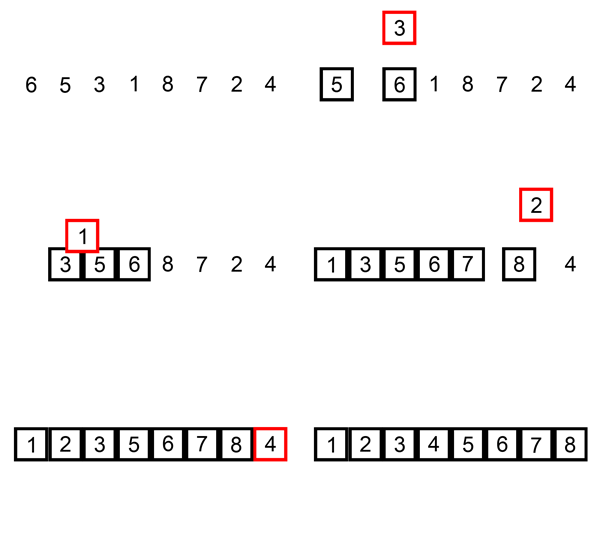
Insert Sort Example

Key Points

  • It does not use extra memory. And, is in-place algorithm.
  • Its stable, as it does not change order of same value elements.
  • It is more efficient in practice than Bubble Sort and Selection Sort
  • It is well suited for small data sets.

Runtime complexity

The algorithm runs on O(n^2) in worst case.

Related Posts

Radix Sort Algorithm

Radix Sort Algorithm

A number consists of digits. Example: 843. Its a 3-digit number. Radix sort…

Counting Sort Algorithm

Counting Sort Algorithm

Counting sort runs on relatively smaller set of input. Counting sort calculates…

Heap Sort Algorithm

Heap Sort Algorithm

This is another very useful sorting algorithm based on Heap data structure. Read…

Quick Sort Algorithm

Quick Sort Algorithm

This algorithm is very useful for large input. And, is quite efficient one. It…

Merge Sort Algorithm

Merge Sort Algorithm

This algorithm is very efficient one, and is classic example of Divide and…

Bubble Sort Algorithm

Bubble Sort Algorithm

This is kind of preliminary technique of sorting. And, this is the first…

Latest Posts

Claude Code Skills — Build a Better Engineering Workflow with AI-Powered Code Reviews, Security Scans, and More

Claude Code Skills — Build a Better Engineering Workflow with AI-Powered Code Reviews, Security Scans, and More

Most developers use Claude Code like a search engine — ask a question, get an…

Building an AI Voicebot for Visitor Check-In — A Practical Guide to Handling the Messy Parts

Building an AI Voicebot for Visitor Check-In — A Practical Guide to Handling the Messy Parts

Every office lobby has the same problem: a visitor walks in, nobody’s at the…

Server Security Best Practices — Complete Hardening Guide for Production Systems

Server Security Best Practices — Complete Hardening Guide for Production Systems

Every breach post-mortem tells the same story: an unpatched service, a…

Staff Engineer Study Plan for MAANG Interviews — The Complete 12-Week Roadmap

Staff Engineer Study Plan for MAANG Interviews — The Complete 12-Week Roadmap

If you’re a Senior Engineer (L5) preparing for Staff (L6+) roles at MAANG…

XSS and CSRF Explained — The Complete Guide with Real Attack Examples and Defenses

XSS and CSRF Explained — The Complete Guide with Real Attack Examples and Defenses

XSS and CSRF have been in the OWASP Top 10 for over a decade. They’re among the…

OWASP Top 10 (2021) — Every Vulnerability Explained with Code

OWASP Top 10 (2021) — Every Vulnerability Explained with Code

The OWASP Top 10 is the industry standard for web application security risks. If…